
*Understanding the research on excessive device use, developmental delay, and autism-like symptoms in young children*
If you've spent any time in homeschool parenting groups lately, you might have seen or heard the term ^"virtual autism" (sometimes called ^“pseudo autism” or ^”pseudo-ASD”) floating around. It's a topic that understandably worries parents — especially as most of us are raising kids in a world of tablets, smartphones, and endless screen time.
As a qualified teacher working closely with homeschooling families, I get asked about this a lot. Parents want to know: is my child's screen habit affecting their development? Does this relate to my child who already has an ASD / PDA diagnosis?
This post pulls together what the current research actually says — no scaremongering, no oversimplifying — so you can make informed decisions for your family.
#What then is "virtual" or "pseudo" autism?
The term was coined in 2018 by Romanian psychologist Marius Zamfir, who used it to describe behavioural difficulties in children aged 0–3 that seemed to stem from sensory-motor and socio-affective deprivation caused by exposure to more than four hours a day of screen-based content. The symptoms he and other clinicians observed — avoidance of eye contact, delayed language, poor social engagement, difficulty tolerating changes in routine — closely resemble the presentation of autism spectrum disorder, without necessarily reflecting the same underlying neurology.
It's important to say clearly: ^ "virtual autism" is not a recognised medical diagnosis. It doesn't appear in the DSM-5 or ICD-11, and it's not considered a real medical condition by many clinicians who work in autism assessment. It's better understood as a descriptive term some researchers and clinicians use for a cluster of developmental symptoms associated with excessive early screen exposure — symptoms that, unlike genetically-based ASD, often improve when screen time is reduced and real-world interaction increases.
#What does the actual research show?
This is genuinely an active and, frankly, contested area of paediatric research — not settled science. But there are some solid data points worth knowing:
- A ^2022 Japanese cohort study of more than 84,000 mother-infant pairs found that among boys, longer screen time at one year of age was significantly associated with an autism spectrum disorder diagnosis at age three.
- A ^longitudinal US study from a research team studying children with a family history of autism found that preschoolers who went on to be diagnosed with autism, or who showed elevated ADHD symptoms, had experienced significantly more screen exposure at 18 months than children without those outcomes, and that greater screen time at 18 months was linked to more autism and ADHD symptoms, and lower developmental achievement, later on.
- Researchers using MRI at ^Cincinnati Children's Hospital, publishing in *JAMA Paediatrics found that toddlers with more screen exposure had less-developed white matter in brain regions responsible for language and literacy — the neural "cabling" that helps different parts of the brain communicate.
- A 2024 review in the *International Journal of Paediatrics and Adolescent Medicine was careful to note that correlation doesn't necessarily mean causation, and more research is needed to understand the mechanisms by which screen exposure might affect brain development — as well as the role of what children are watching and how involved parents are during screen time.
^The honest scientific verdict: there's a growing, credible body of evidence linking excessive early screen exposure to developmental delay and autism-like symptoms in some children. What's far less certain is causation, mechanism, and how this differs for children who are genetically predisposed to autism versus those who aren't.
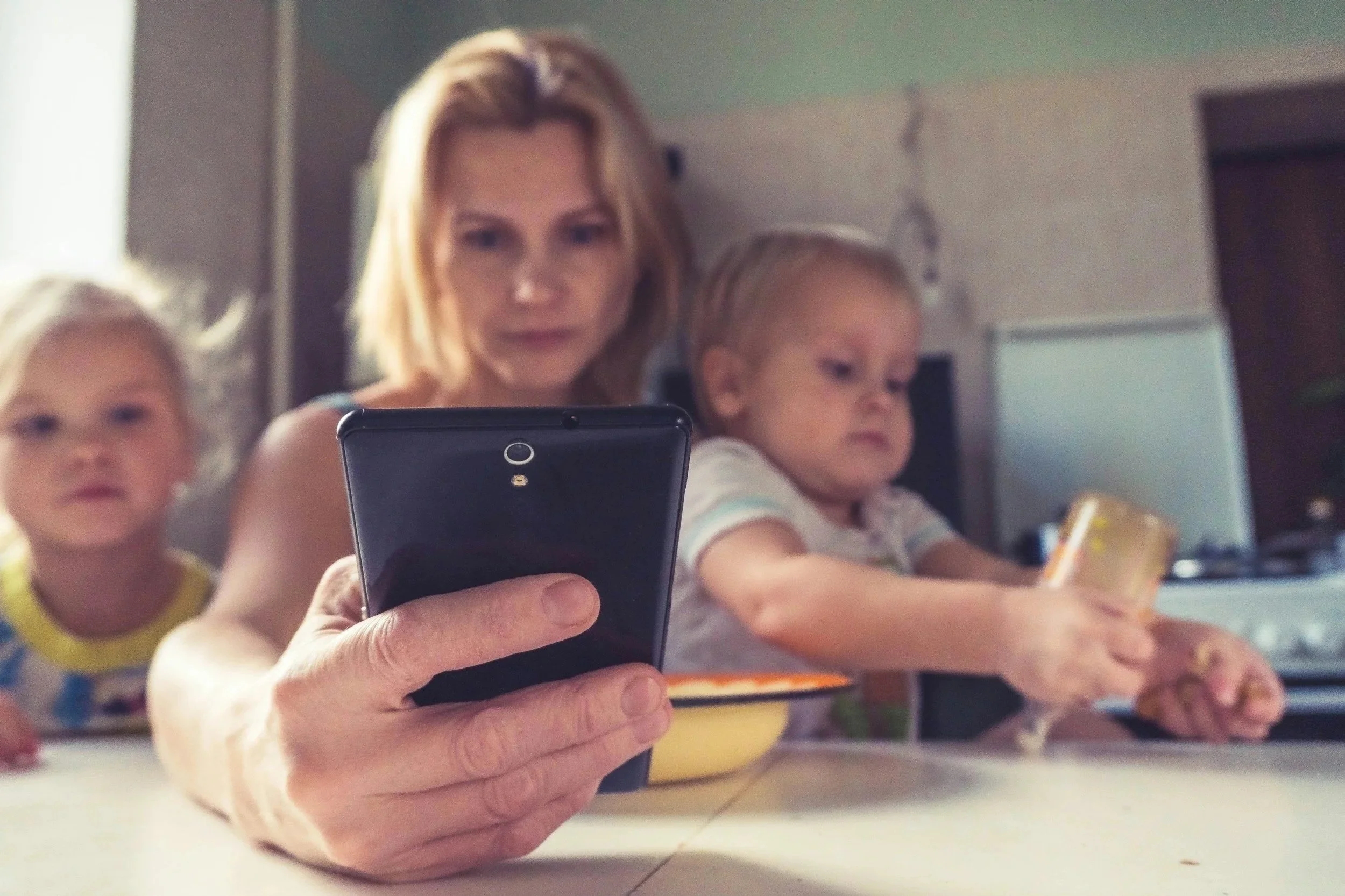
Taking notice of the difference between active and passive screen use for all family members can help awareness.
# Why this matters — and why it's easy to misunderstand
Here's the critical distinction, and it's one I want every parent reading this to walk away with:
^Autism spectrum disorder is a lifelong, primarily genetic neurodevelopmental condition. It is not caused by screens, vaccines, parenting style, or anything else that's within a parent's control to simply "undo." If your child has a formal ASD or PDA diagnosis from a qualified professional, that diagnosis stands — screen time didn't create it, and cutting screen time won't make it disappear. Please don't let a blog post (mine included) become a source of guilt or self-doubt about a diagnosis your child's specialists have made.
What the "virtual autism" research is actually describing is different: ^a set of autism-*like* behaviours in very young children (mostly under five) that appear to be a response to environment — specifically, long hours of passive screen exposure combined with reduced face-to-face interaction, play, and movement. In these cases, symptoms often improve significantly once screen time drops and real-world engagement increases.
Misdiagnosis in either direction has consequences. Labelling a genuinely autistic child's traits as "just screen time" can delay the therapy and support they need. Equally, panicking that ordinary tablet use has permanently altered a child's brain isn't supported by the evidence either. If you have concerns about your child's development, the right next step is always a proper assessment with a paediatrician, speech pathologist, or developmental specialist — not a Google search (however well-referenced).
# What this means for homeschooling families
This is exactly the kind of topic where homeschooling and hands-on, in-person learning genuinely has an advantage. A few practical takeaways:
- ^Prioritise real-world, hands-on learning over screen-based learning, especially for children under six. Face-to-face conversation, physical play, art, nature exploration, and direct instruction all build the language and social-engagement skills that passive screen time can crowd out.
- ^Notice the difference between active and passive screen use. A video call with grandma or an interactive, co-viewed educational app is a very different experience for a developing brain than solo, passive video consumption.
- ^If you're concerned, get a professional opinion early. Early intervention — whatever the underlying cause — leads to better outcomes.
- ^Don't second-guess an existing ASD or PDA diagnosis based on screen habits alone. These conditions are complex, and true understanding of a child who learns differently comes from proper assessment and lived experience with that child, not from a single risk factor.
# Where The Touring Teacher fits in
This is a big part of why I built The Touring Teacher the way I did. My mobile classroom brings gently structured, hands-on learning directly to your homeschooling family's door — real materials, real conversation, real relationship-building, delivered by a qualified teacher who genuinely understands kids who learn differently, including those with ASD, PDA, and other learning differences.
Every session comes with a detailed feedback report linking what your child did back to the relevant curriculum, with photos and descriptions that double as solid evidence for your annual moderation visit. You get professional support, someone to share the educational load with, and the peace of mind that your child's learning — on and off the screen — is genuinely on track.
If you'd like to chat about how a mobile classroom visit could support your homeschooling journey, particularly for a child who learns differently, I'd love to hear from you.
Sources
1. Kushima, M. et al. (2022). Association Between Screen Time Exposure in Children at 1 Year of Age and Autism Spectrum Disorder at 3 Years of Age. JAMA Paediatrics.
2. Heffler, K. F. et al. Toddler Screen Time: Longitudinal Associations with Autism and ADHD Symptoms and Developmental Outcomes. PMC.
3. Detroja, S. & Bhatia, G. (2024). Early Screen Exposure and Developmental Abnormalities: Understanding the Trepidations of "Virtual Autism." SAGE Journals.
4. "Virtual Autism" and Excessive Screen Exposure in Children. (2024). International Journal of Paediatrics and Adolescent Medicine.
5. FOX 32 Chicago (2024). 'Did I cause this?' Examining the reality behind claims of 'virtual autism.'
*This article is for general information only and is not a substitute for professional medical or developmental advice. If you have concerns about your child's development, please speak with your GP, paediatrician, or a qualified developmental specialist.